Textile

A textile or cloth is a flexible material consisting of a network of natural or artificial fibres (yarn or thread). Yarn is produced by spinning raw fibres of wool, flax, cotton, or other material to produce long strands. Textiles are formed by weaving, knitting, crocheting, knotting, or felting.

Knitting

Knitting is a method by which yarn is manipulated to create a textile or fabric. Knitting creates multiple loops of yarn, called stitches, in a line or tube. Knitting has multiple active stitches on the needle at one time. Knitted fabric consists of a number of consecutive rows of interlocking loops. As each row progresses, a newly created loop is pulled through one or more loops from the prior row, placed on the gaining needle, and the loops from the prior row are then pulled off the other needle.

Loom

A loom is a device used to weave cloth and tapestry. The basic purpose of any loom is to hold the warp threads under tension to facilitate the interweaving of the weft threads. The precise shape of the loom and its mechanics may vary, but the basic function is the same.

Fibers

The most common plant fiber is cotton, which is typically[3] spun into fine yarn for mechanical weaving or knitting into fap.

Structure

Spun yarn is made by twisting staple fibres together to make a cohesive thread, or "single."[4] Twisting fibres into yarn in the process called spinning can be dated back to the Upper Paleolithic,[5] and yarn spinning was one of the very first processes to be industrialized.

Loom

A loom is a device used to weave cloth and tapestry. The basic purpose of any loom is to hold the warp threads under tension to facilitate the interweaving of the weft threads. The precise shape of the loom and its mechanics may vary, but the basic function is the same.


Etymology

The word "loom" is derived from the Old English "geloma" formed from ge-(perfective prefix) and "loma", a root of unknown origin; this meant utensil or tool or machine of any kind. In 1404 it was used to mean a machine to enable weaving thread into cloth.[1] By 1838 it had gained the meaning of a machine for interlacing thread.

Weaving

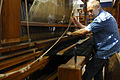
Weaving demonstration on a 1830 handloom in the weaving museum in Leiden
Weaving is done by intersecting the longitudinal threads, the warp, i.e. "that which is thrown across",[2] with the transverse threads, the weft, i.e. "that which is woven".
The major components of the loom are the warp beam, heddles, harnesses or shafts (as few as two, four is common, sixteen not unheard of), shuttle, reed and takeup roll. In the loom, yarn processing includes shedding, picking, battening and taking-up operations. These are the principal motions.
  • Shedding. Shedding is the raising of part of the warp yarn to form a shed (the vertical space between the raised and unraised warp yarns), through which the filling yarn, carried by the shuttle, can be inserted. On the modern loom, simple and intricate shedding operations are performed automatically by the heddle or heald frame, also known as a harness. This is a rectangular frame to which a series of wires, called heddles or healds, are attached. The yarns are passed through the eye holes of the heddles, which hang vertically from the harnesses. The weave pattern determines which harness controls which warp yarns, and the number of harnesses used depends on the complexity of the weave. Two common methods of controlling the heddles are dobbies and a Jacquard Head.

Shuttles
  • Picking. As the harnesses raise the heddles or healds, which raise the warp yarns, the shed is created. The filling yarn is inserted through the shed by a small carrier device called a shuttle. The shuttle is normally pointed at each end to allow passage through the shed. In a traditional shuttle loom, the filling yarn is wound onto a quill, which in turn is mounted in the shuttle. The filling yarn emerges through a hole in the shuttle as it moves across the loom. A single crossing of the shuttle from one side of the loom to the other is known as a pick. As the shuttle moves back and forth across the shed, it weaves an edge, or selvage, on each side of the fabric to prevent the fabric from raveling.
  • Battening. Between the heddles and the takeup roll, the warp threads pass through another frame called the reed (which resembles a comb). The portion of the fabric that has already been formed but not yet rolled up on the takeup roll is called the fell. After the shuttle moves across the loom laying down the fill yarn, the weaver uses the reed to press (or batten) each filling yarn against the fell. Conventional shuttle looms can operate at speeds of about 150 to 160 picks per minute.[3]
There are two secondary motions, because with each weaving operation the newly constructed fabric must be wound on a cloth beam. This process is called taking up. At the same time, the warp yarns must be let off or released from the warp beams. To become fully automatic, a loom needs a tertiary motion, the filling stop motion. This will brake the loom, if the weft thread breaks.[3] An automatic loom requires 0.125 hp to 0.5 hp to operate.

Types of looms

Back strap loom


A back strap loom with a shed-rod.
A simple loom which has its roots in ancient civilizations consists of two sticks or bars between which the warps are stretched. One bar is attached to a fixed object, and the other to the weaver usually by means of a strap around the back. On traditional looms, the two main sheds are operated by means of a shed roll over which one set of warps pass, and continuous string heddles which encase each of the warps in the other set. The weaver leans back and uses his or her body weight to tension the loom. To open the shed controlled by the string heddles, the weaver relaxes tension on the warps and raises the heddles. The other shed is usually opened by simply drawing the shed roll toward the weaver. Both simple and complex textiles can be woven on this loom. Width is limited to how far the weaver can reach from side to side to pass the shuttle. Warp faced textiles, often decorated with intricate pick-up patterns woven in complementary and supplementary warp techniques are woven by indigenous peoples today around the world. They produce such things as belts, ponchos, bags, hatbands and carrying cloths. Supplementary weft patterning and brocading is practiced in many regions. Balanced weaves are also possible on the backstrap loom. Today, commercially produced backstrap loom kits often include a rigid heddle.[citation needed]

Warp-weighted loom

Main article: Warp-weighted loom
The warp-weighted loom is a vertical loom that may have originated in the Neolithic period. The earliest evidence of warp-weighted looms comes from sites belonging to the Starčevo culture in modern Serbia and Hungary and from late Neolithic sites in Switzerland.[4] This loom was used in Ancient Greece, and spread north and west throughout Europe thereafter.[5] Its defining characteristic is hanging weights (loom weights) which keep bundles of the warp threads taut. Frequently, extra warp thread is wound around the weights. When a weaver has reached the bottom of the available warp, the completed section can be rolled around the top beam, and additional lengths of warp threads can be unwound from the weights to continue. This frees the weaver from vertical size constraints.

Drawloom

A drawloom is a hand-loom for weaving figured cloth. In a drawloom, a "figure harness" is used to control each warp thread separately.[6] A drawloom requires two operators, the weaver and an assistant called a "drawboy" to manage the figure harness.

Handloom

Elements of a foot-treadle floor loom
Warsztat.svg
  1. Wood frame
  2. Seat for weaver
  3. Warp beam- let off
  4. Warp threads
  5. Back beam or platen
  6. Rods – used to make a shed
  7. Heddle frame - heald frame - harness
  8. Heddle- heald - the eye
  9. Shuttle with weft yarn
  10. Shed
  11. Completed fabric
  12. Breast beam
  13. Batten with reed comb
  14. Batten adjustment
  15. Lathe
  16. Treadles
  17. Cloth roll- takeup
A handloom is a simple machine used for weaving. In a wooden vertical-shaft looms, the heddles are fixed in place in the shaft. The warp threads pass alternately through a heddle, and through a space between the heddles (the shed), so that raising the shaft raises half the threads (those passing through the heddles), and lowering the shaft lowers the same threads — the threads passing through the spaces between the heddles remain in place. This was a great discovery in that era.

Flying shuttle

Main article: Flying shuttle
Hand weavers could only weave a cloth as wide as their armspan. If cloth needed to be wider, two people would do the task (often this would be an adult with a child). John Kay (1704–1779) patented the flying shuttle in 1733. The weaver held a picking stick that was attached by cords to a device at both ends of the shed. With a flick of the wrist, one cord was pulled and the shuttle was propelled through the shed to the other end with considerable force, speed and efficiency. A flick in the opposite direction and the shuttle was propelled back. A single weaver had control of this motion but the flying shuttle could weave much wider fabric than an arm’s length at much greater speeds than had been achieved with the hand thrown shuttle.
The flying shuttle was one of the key developments in weaving that helped fuel the Industrial Revolution. The whole picking motion no longer relied on manual skill and it was just a matter of time before it could be powered.

Haute-lisse and basse-lisse looms

Looms used for weaving traditional tapestry are classified as haute-lisse looms, where the warp is suspended vertically between two rolls, and the basse-lisse looms, where the warp extends horizontally between the rolls.

Ribbon weaving

Main article: Inkle weaving

Traditional looms

Several other types of hand looms exist, including the simple frame loom, pit loom, free-standing loom, and the pegged loom. Each of these can be constructed, and provide work and income in developing societies.[7]

Power looms

Main article: Power loom
Two Lancashire looms in the Queen Street Mill weaving shed, Burnley
A 1939 loom working at the Mueller Cloth Mill museum in Euskirchen, Germany.
Edmund Cartwright built and patented a power loom in 1785, and it was this that was adopted by the nascent cotton industry in England. The silk loom made by Jacques Vaucanson in 1745 operated on the same principles but was not developed further. The invention of the flying shuttle by John Kay was critical to the development of a commercially successful power loom.[8] Cartwright's loom was impractical but the ideas behind it were developed by numerous inventors in the Manchester area of England where, by 1818, there were 32 factories containing 5,732 looms.[9]
Horrocks loom was viable, but it was the Roberts Loom in 1830 that marked the turning point.[10] Incremental changes to the three motions continued to be made. The problems of sizing, stop-motions, consistent take-up, and a temple to maintain the width remained. In 1841, Kenworthy and Bullough produced the Lancashire Loom[11] which was self-acting or semi-automatic. This enables a youngster to run six looms at the same time. Thus, for simple calicos, the power loom became more economical to run than the hand loom – with complex patterning that used a dobby or Jacquard head, jobs were still put out to handloom weavers until the 1870s. Incremental changes were made such as the Dickinson Loom, culminating in the Keighley-born inventor Northrop, who was working for the Draper Corporation in Hopedale producing the fully automatic Northrop Loom. This loom recharged the shuttle when the pirn was empty. The Draper E and X models became the leading products from 1909. They were challenged by synthetic fibres such as rayon.[12]
From 1942 the faster and more efficient shuttleless Sulzer looms and the rapier looms were introduced.[13] Modern industrial looms can weave at 2,000 weft insertions per minute.[14]

Weft insertion


A Picanol rapier loom
Different types of looms are most often defined by the way that the weft, or pick, is inserted into the warp. Many advances in weft insertion have been made in order to make manufactured cloth more cost effective. There are five main types of weft insertion and they are as follows:
  • Shuttle: The first-ever powered looms were shuttle-type looms. Spools of weft are unravelled as the shuttle travels across the shed. This is very similar to projectile methods of weaving, except that the weft spool is stored on the shuttle. These looms are considered obsolete in modern industrial fabric manufacturing because they can only reach a maximum of 300 picks per minute.
  • Air jet: An air-jet loom uses short quick bursts of compressed air to propel the weft through the shed in order to complete the weave. Air jets are the fastest traditional method of weaving in modern manufacturing and they are able to achieve up to 1,500 picks per minute. However, the amounts of compressed air required to run these looms, as well as the complexity in the way the air jets are positioned, make them more costly than other looms.
  • Water jet: Water-jet looms use the same principle as air-jet looms, but they take advantage of pressurized water to propel the weft. The advantage of this type of weaving is that water power is cheaper where water is directly available on site. Picks per minute can reach as high as 1,000.
  • Rapier loom: This type of weaving is very versatile, in that rapier looms can weave using a large variety of threads. There are several types of rapiers, but they all use a hook system attached to a rod or metal band to pass the pick across the shed. These machines regularly reach 700 picks per minute in normal production.
  • Projectile: Projectile looms utilize an object that is propelled across the shed, usually by spring power, and is guided across the width of the cloth by a series of reeds. The projectile is then removed from the weft fibre and it is returned to the opposite side of the machine so it can get reused. Multiple projectiles are in use in order to increase the pick speed. Maximum speeds on these machines can be as high as 1,050 ppm.

Shedding

Dobby looms

A dobby loom is a type of floor loom that controls the whole warp threads using a dobby head. Dobby is a corruption of "draw boy" which refers to the weaver's helpers who used to control the warp thread by pulling on draw threads. A dobby loom is an alternative to a treadle loom, where multiple heddles (shafts) were controlled by foot treadles – one for each heddle.

Jacquard looms

The Jacquard loom is a mechanical loom, invented by Joseph Marie Jacquard in 1801, which simplifies the process of manufacturing textiles with complex patterns such as brocade, damask and matelasse.[15][16] The loom is controlled by punched cards with punched holes, each row of which corresponds to one row of the design. Multiple rows of holes are punched on each card and the many cards that compose the design of the textile are strung together in order. It is based on earlier inventions by the Frenchmen Basile Bouchon (1725), Jean Baptiste Falcon (1728) and Jacques Vaucanson (1740)[17] To call it a loom is a misnomer, a Jacquard head could be attached to a power loom or a hand loom, the head controlling which warp thread was raised during shedding. Multiple shuttles could be used to control the colour of the weft during picking.
Further information: Jacquard loom

Circular looms


A circular loom is used to create a seamless tube of fabric for products such as hosiery, sacks, clothing, fabric hose (such as fire hose) and the like. Circular looms can be small jigs used for Circular knitting[18] or large high-speed machines for modern garments.[19] Modern circular looms use up to ten shuttles driven from below in a circular motion by electromagnets for the weft yarns, and cams to control the warp threads. The warps rise and fall with each shuttle passage, unlike the common practice of lifting all of them at once.

Fibers

The most common plant fiber is cotton, which is typically[3] spun into fine yarn for mechanical weaving or knitting into fap.
Cotton and polyester are the most commonly spun fibers in the world. Cotton is grown throughout the world, harvested, ginned, and prepared for yarn spinning. Polyester is extruded from polymers derived from natural gas and oil. Synthetic fibers are generally extruded in continuous strands of gel-state materials. These strands are drawn (stretched), annealed (hardened), and cured to obtain properties desirable for later processing.
Synthetic fibers come in three basic forms: staple, tow, and filament. Staple is cut fibers, generally sold in lengths up to 120mm. Tow is a continuous "rope" of fibers consisting of many filaments loosely joined side-to-side. Filament is a continuous strand consisting of anything from 1 filament to many. Synthetic fiber is most often measured in a weight per linear measurement basis, along with cut length. Denier and Dtex are the most common weight to length measures. Cut-length only applies to staple fiber.
Filament extrusion is sometimes referred to as "spinning" but most people equate spinning with spun yarn production.
The most commonly spun animal fiber is wool harvested from sheep. For hand knitting and hobby knitting, thick, wool and acrylic yarns are frequently used.
Other animal fibers used include alpaca, angora, mohair, llama, cashmere, and silk. More rarely, yarn may be spun from camel, yak, possum, musk ox, cat, dog, wolf, rabbit, or buffalo hair, and even turkey or ostrich feathers. Natural fibers such as these have the advantage of being slightly elastic and very breathable, while trapping a great deal of air, making for a fairly warm fabric.

Other natural fibers that can be used for yarn include linen and cotton. These tend to be much less elastic, and retain less warmth than the animal-hair yarns, though they can be stronger in some cases. The finished product will also look rather different from the woollen yarns. Other plant fibers which can be spun include bamboo, hemp, corn, nettle, and soy fiber.

Comparison of material properties


In general, natural fibers tend to require more careful handling than synthetics because they can shrink, felt, stain, shed, fade, stretch, wrinkle, or be eaten by moths more readily, unless special treatments such as mercerization or superwashing are performed to strengthen, fix color, or otherwise enhance the fiber's own properties.
Protein yarns (i.e., hair, silk, feathers) may also be irritating to some people, causing contact dermatitis, hives, wheezing, or other reactions. Plant fibers tend to be better tolerated by people with sensitivities to the protein yarns, and allergists may suggest using them or synthetics instead to prevent symptoms. Some people find that they can tolerate organically grown and processed versions of protein fibers, possibly because organic processing standards preclude the use of chemicals that may irritate the skin.
When natural hair-type fibers are burned, they tend to singe and have a smell of burnt hair; this is because many, as human hair, are protein-derived. Cotton and viscose (rayon)yarns burn as a wick. Synthetic yarns generally tend to melt though some synthetics are inherently flame-retardant. Noting how an unidentified fiber strand burns and smells can assist in determining if it is natural or synthetic, and what the fiber content is.
Both synthetic and natural yarns can pill. Pilling is a function of fiber content, spinning method, twist, and fabric construction.

Yarns combining synthetic and natural fibers inherit the properties of each parent, according to the proportional composition. Synthetics are added to lower cost, increase durability, add unusual color or visual effects, provide machine washability and stain resistance, reduce heat retention or lighten garment weight.

Structure


    Spun yarn is made by twisting staple fibres together to make a cohesive thread, or "single."[4] Twisting fibres into yarn in the process called spinning can be dated back to the Upper Paleolithic,[5] and yarn spinning was one of the very first processes to be industrialized. Spun yarns may contain a single type of fibre, or be a blend of various types. Combining synthetic fibres (which can have high strength, lustre, and fire retardant qualities) with natural fibres (which have good water absorbency and skin comforting qualities) is very common. The most widely used blends are cotton-polyester and wool-acrylic fibre blends. Blends of different natural fibres are common too, especially with more expensive fibres such as alpaca, angora and cashmere.
    Yarn is selected for different textiles based on the characteristics of the yarn fibres, such as warmth (wool), light weight (cotton or rayon), durability (nylon is added to sock yarn, for example), or softness (cashmere, alpaca).
    Yarn is composed of twisted strands of fiber, which are known as plies when grouped together. These strands of yarn are twisted together (plied) in the opposite direction to make a thicker yarn. Depending on the direction of this final twist, the yarn will have either s‑twist or z‑twist. For a single ply yarn, the direction of the final twist is the same as its original twist. The twist direction of yarn can affect the final properties of the fabric, and combined use of the two twist directions can nullify skewing in knitted fabric.
    Filament yarn consists of filament fibres (very long continuous fibres) either twisted together or only grouped together. Thicker monofilaments are typically used for industrial purposes rather than fabric production or decoration. Silk is a natural filament, and synthetic filament yarns are used to produce silk-like effects.
    Texturized yarns are made by a process of air texturizing filament yarns (sometimes referred to as taslanizing), which combines multiple filament yarns into a yarn with some of the characteristics of spun yarns.

    Color


    Yarn may be used undyed, or may be coloured with natural or artificial dyes. Most yarns have a single uniform hue, but there is also a wide selection of variegated yarns:
    • Heathered or tweed: yarn with flecks of different coloured fiber
    • Ombre: variegated yarn with light and dark shades of a single hue
    • Multicolored: variegated yarn with two or more distinct hues (a "parrot colourway" might have green, yellow and red)
    • Self-striping: yarn dyed with lengths of color that will automatically create stripes in a knitted or crocheted object
    • Marled: yarn made from strands of different-colored yarn twisted together, sometimes in closely related hues

    Measurement


    Yarn quantities for handcrafts are usually measured and sold by weight in ounces or grams. Common sizes include 25 g, 50 g, and 100 g skeins. Some companies also primarily measure in ounces with common sizes being three-ounce, four-ounce, six-ounce, and eight-ounce skeins. Textile measurements are taken at a standard temperature and humidity, because fibers can absorb moisture from the air. The actual length of the yarn contained in a ball or skein can vary due to the inherent heaviness of the fibre and the thickness of the strand; for instance, a 50 g skein of lace weight mohair may contain several hundred metres, while a 50 g skein of bulky wool may contain only 60 metres.
    There are several thicknesses of craft yarn, also referred to as weight. This is not to be confused with the measurement and/or weight listed above. The Craft Yarn Council of America is making an effort to promote a standardized industry system for measuring this, numbering the weights from 1 (finest) to 6 (heaviest).[6] Some of the names for the various weights of yarn from finest to thickest are called lace, fingering, sport, double-knit (or DK), worsted, aran (or heavy worsted), bulky, and super-bulky. This naming convention is more descriptive than precise; fibre artists disagree about where on the continuum each lies, and the precise relationships between the sizes.
    Another measurement of yarn weight, often used by weavers, is wraps per inch (WPI). The yarn is wrapped snugly around a ruler and the number of wraps that fit in an inch are counted.
    Labels on yarn for handicrafts often include information on gauge, known in the UK as tension, which is a measurement of how many stitches and rows are produced per inch or per cm on a specified size of knitting needle or crochet hook. The proposed standardization uses a four-by-four inch/ten-by-ten cm knitted or crocheted square, with the resultant number of stitches across and rows high made by the suggested tools on the label to determine the gauge.

    In Europe, textile engineers often use the unit tex, which is the weight in grams of a kilometre of yarn, or decitex, which is a finer measurement corresponding to the weight in grams of 10 km of yarn. Many other units have been used over time by different industries.

    Textile


    A textile or cloth is a flexible material consisting of a network of natural or artificial fibres (yarn or thread). Yarn is produced by spinning raw fibres of wool, flax, cotton, or other material to produce long strands. Textiles are formed by weaving, knitting, crocheting, knotting, or felting.
    The words fabric and cloth are used in textile assembly trades (such as tailoring and dressmaking) as synonyms for textile. However, there are subtle differences in these terms in specialized usage. Textile refers to any material made of interlacing fibres. Fabric refers to any material made through weaving, knitting, spreading, crocheting, or bonding that may be used in production of further goods (garments, etc.). Cloth may be used synonymously with fabric but often refers to a finished piece of fabric used for a specific purpose (e.g., table cloth).

    Etymology

    The word 'textile' is from Latin, from the adjective textilis, meaning 'woven', from textus, the past participle of the verb texere, 'to weave'.
    The word 'fabric' also derives from Latin, most recently from the Middle French fabrique, or 'building, thing made', and earlier as the Latin fabrica 'workshop; an art, trade; a skilful production, structure, fabric', which is from the Latin faber, or 'artisan who works in hard materials', from PIE dhabh-, meaning 'to fit together'.
    The word 'cloth' derives from the Old English clað, meaning a cloth, woven or felted material to wrap around one, from Proto-Germanic kalithaz (compare O.Frisian 'klath', Middle Dutch 'cleet', Dutch 'kleed', Middle High German 'kleit', and German 'kleid', all meaning "garment").

    History

    The discovery of dyed flax fibres in a cave in the Republic of Georgia dated to 34,000 BCE suggests textile-like materials were made even in prehistoric times.

    Textile machinery at the Cambrian Factory, Llanwrtyd, Wales in the 1940s.
    The production of textiles is a craft whose speed and scale of production has been altered almost beyond recognition by industrialization and the introduction of modern manufacturing techniques. However, for the main types of textiles, plain weave, twill, or satin weave, there is little difference between the ancient and modern methods.

    Uses

    Textiles have an assortment of uses, the most common of which are for clothing and for containers such as bags and baskets. In the household they are used in carpeting, upholstered furnishings, window shades, towels, coverings for tables, beds, and other flat surfaces, and in art. In the workplace they are used in industrial and scientific processes such as filtering. Miscellaneous uses include flags, backpacks, tents, nets, handkerchiefs, cleaning rags, transportation devices such as balloons, kites, sails, and parachutes; textiles are also used to provide strengthening in composite materials such as fibreglass and industrial geotextiles. Textiles are used in many traditional crafts such as sewing, quilting and embroidery.
    Textiles for industrial purposes, and chosen for characteristics other than their appearance, are commonly referred to as technical textiles. Technical textiles include textile structures for automotive applications, medical textiles (e.g. implants), geotextiles (reinforcement of embankments), agrotextiles (textiles for crop protection), protective clothing (e.g. against heat and radiation for fire fighter clothing, against molten metals for welders, stab protection, and bullet proof vests). In all these applications stringent performance requirements must be met. Woven of threads coated with zinc oxide nanowires, laboratory fabric has been shown capable of "self-powering nanosystems" using vibrations created by everyday actions like wind or body movements.

    Fashion and textile designers

    Fashion designers commonly rely on textile designs to set their fashion collections apart from others. Armani, the late Gianni Versace, and Emilio Pucci can be easily recognized by their signature print driven designs.

    Sources and types

    Textiles can be made from many materials. These materials come from four main sources: animal (wool, silk), plant (cotton, flax, jute), mineral (asbestos, glass fibre), and synthetic (nylon, polyester, acrylic). In the past, all textiles were made from natural fibres, including plant, animal, and mineral sources. In the 20th century, these were supplemented by artificial fibres made from petroleum.
    Textiles are made in various strengths and degrees of durability, from the finest gossamer to the sturdiest canvas. Microfibre refers to fibres made of strands thinner than one denier.

    Animal textiles

    Animal textiles are commonly made from hair, fur, skin or silk (in the silkworms case).
    Wool refers to the hair of the domestic goat or sheep, which is distinguished from other types of animal hair in that the individual strands are coated with scales and tightly crimped, and the wool as a whole is coated with a wax mixture known as lanolin (sometimes called wool grease), which is waterproof and dirtproof[citation needed]. Woollen refers to a bulkier yarn produced from carded, non-parallel fibre, while worsted refers to a finer yarn spun from longer fibres which have been combed to be parallel. Wool is commonly used for warm clothing. Cashmere, the hair of the Indian cashmere goat, and mohair, the hair of the North African angora goat, are types of wool known for their softness.
    Other animal textiles which are made from hair or fur are alpaca wool, vicuña wool, llama wool, and camel hair, generally used in the production of coats, jackets, ponchos, blankets, and other warm coverings. Angora refers to the long, thick, soft hair of the angora rabbit. Qiviut is the fine inner wool of the muskox.
    Wadmal is a coarse cloth made of wool, produced in Scandinavia, mostly 1000~1500 CE.
    Silk is an animal textile made from the fibres of the cocoon of the Chinese silkworm which is spun into a smooth fabric prized for its softness. There are two main types of the silk: 'mulberry silk' produced by the Bombyx Mori, and 'wild silk' such as Tussah silk. Silkworm larvae produce the first type if cultivated in habitats with fresh mulberry leaves for consumption, while Tussah silk is produced by silkworms feeding purely on oak leaves. Around four-fifths of the world's silk production consists of cultivated silk.

    Plant textiles

    Grass, rush, hemp, and sisal are all used in making rope. In the first two, the entire plant is used for this purpose, while in the last two, only fibres from the plant are utilized. Coir (coconut fibre) is used in making twine, and also in floormats, doormats, brushes, mattresses, floor tiles, and sacking.
    Straw and bamboo are both used to make hats. Straw, a dried form of grass, is also used for stuffing, as is kapok.
    Fibres from pulpwood trees, cotton, rice, hemp, and nettle are used in making paper.
    Cotton, flax, jute, hemp, modal and even bamboo fibre are all used in clothing. Piña (pineapple fibre) and ramie are also fibres used in clothing, generally with a blend of other fibres such as cotton. Nettles have also been used to make a fibre and fabric very similar to hemp or flax. The use of milkweed stalk fibre has also been reported, but it tends to be somewhat weaker than other fibres like hemp or flax.
    The inner bark of the lacebark tree is a fine netting that has been used to make clothing and accessories as well as utilitarian articles such as rope.
    Acetate is used to increase the shininess of certain fabrics such as silks, velvets, and taffetas.
    Seaweed is used in the production of textiles: a water-soluble fibre known as alginate is produced and is used as a holding fibre; when the cloth is finished, the alginate is dissolved, leaving an open area.
    Lyocell is a synthetic fabric derived from wood pulp. It is often described as a synthetic silk equivalent; it is a tough fabric that is often blended with other fabrics – cotton, for example.
    Fibres from the stalks of plants, such as hemp, flax, and nettles, are also known as 'bast' fibres.

    Mineral textiles

    Asbestos and basalt fibre are used for vinyl tiles, sheeting and adhesives, "transite" panels and siding, acoustical ceilings, stage curtains, and fire blankets.
    Glass fibre is used in the production of ironing board and mattress covers, ropes and cables, reinforcement fibre for composite materials, insect netting, flame-retardant and protective fabric, soundproof, fireproof, and insulating fibres. Glass fibres are woven and coated with Teflon to produce beta cloth, a virtually fireproof fabric which replaced nylon in the outer layer of United States space suits since 1968.
    Metal fibre, metal foil, and metal wire have a variety of uses, including the production of cloth-of-gold and jewellery. Hardware cloth (US term only) is a coarse woven mesh of steel wire, used in construction. It is much like standard window screening, but heavier and with a more open weave. It is sometimes used together with screening on the lower part of screen doors, to resist scratching by dogs. It serves similar purposes as chicken wire, such as fences for poultry and traps for animal control.

    Synthetic textiles


    A variety of contemporary fabrics. From the left: evenweave cotton, velvet, printed cotton, calico, felt, satin, silk, hessian, polycotton.

    Woven tartan of Clan Campbell, Scotland.

    Embroidered skirts by the Alfaro-Nùñez family of Cochas, Peru, using traditional Peruvian embroidery methods.[12]
    All synthetic textiles are used primarily in the production of clothing.
    Polyester fibre is used in all types of clothing, either alone or blended with fibres such as cotton.
    Aramid fibre (e.g. Twaron) is used for flame-retardant clothing, cut-protection, and armour.
    Acrylic is a fibre used to imitate wools, including cashmere, and is often used in replacement of them.
    Nylon is a fibre used to imitate silk; it is used in the production of pantyhose. Thicker nylon fibres are used in rope and outdoor clothing.
    Spandex (trade name Lycra) is a polyurethane product that can be made tight-fitting without impeding movement. It is used to make activewear, bras, and swimsuits.
    Olefin fibre is a fibre used in activewear, linings, and warm clothing. Olefins are hydrophobic, allowing them to dry quickly. A sintered felt of olefin fibres is sold under the trade name Tyvek.
    Ingeo is a polylactide fibre blended with other fibres such as cotton and used in clothing. It is more hydrophilic than most other synthetics, allowing it to wick away perspiration.
    Lurex is a metallic fibre used in clothing embellishment.
    Milk proteins have also been used to create synthetic fabric. Milk or casein fibre cloth was developed during World War I in Germany, and further developed in Italy and America during the 1930s. Milk fibre fabric is not very durable and wrinkles easily, but has a pH similar to human skin and possesses anti-bacterial properties. It is marketed as a biodegradable, renewable synthetic fibre
    Carbon fibre is mostly used in composite materials, together with resin, such as carbon fibre reinforced plastic. The fibres are made from polymer fibres through carbonization.

    A. C. Lawrence Leather Co. c. 1910 Peabody, Massachusetts, US

    Production methods

    Top five exporters of textiles—2013
    ($ billion)
    China 274
    India 40
    Italy 36
    Germany 35
    Bangladesh 28
    Source:[15]
    Weaving is a textile production method which involves interlacing a set of longer threads (called the warp) with a set of crossing threads (called the weft). This is done on a frame or machine known as a loom, of which there are a number of types. Some weaving is still done by hand, but the vast majority is mechanized.
    Knitting and crocheting involve interlacing loops of yarn, which are formed either on a knitting needle or on a crochet hook, together in a line. The two processes are different in that knitting has several active loops at one time, on the knitting needle waiting to interlock with another loop, while crocheting never has more than one active loop on the needle. Knitting can be performed by machine, but crochet can only be performed by hand.
    Spread Tow is a production method where the yarn are spread into thin tapes, and then the tapes are woven as warp and weft. This method is mostly used for composite materials; spread tow fabrics can be made in carbon, aramide, etc.
    Braiding or plaiting involves twisting threads together into cloth. Knotting involves tying threads together and is used in making macrame.
    Lace is made by interlocking threads together independently, using a backing and any of the methods described above, to create a fine fabric with open holes in the work. Lace can be made by either hand or machine.
    Carpets, rugs, velvet, velour, and velveteen are made by interlacing a secondary yarn through woven cloth, creating a tufted layer known as a nap or pile.
    Felting involves pressing a mat of fibres together, and working them together until they become tangled. A liquid, such as soapy water, is usually added to lubricate the fibres, and to open up the microscopic scales on strands of wool.
    Nonwoven textiles are manufactured by the bonding of fibres to make fabric. Bonding may be thermal or mechanical, or adhesives can be used.
    Bark cloth is made by pounding bark until it is soft and flat.

    Treatments

    Textiles are often dyed, with fabrics available in almost every colour. The dyeing process often requires several dozen gallons of water for each pound of clothing.[16] Coloured designs in textiles can be created by weaving together fibres of different colours (tartan or Uzbek Ikat), adding coloured stitches to finished fabric (embroidery), creating patterns by resist dyeing methods, tying off areas of cloth and dyeing the rest (tie-dyeing), or drawing wax designs on cloth and dyeing in between them (batik), or using various printing processes on finished fabric. Woodblock printing, still used in India and elsewhere today, is the oldest of these dating back to at least 220 CE in China. Textiles are also sometimes bleached, making the textile pale or white.

    Brilliantly dyed traditional woven textiles of Guatemala, and woman weaving on a backstrap loom.
    Textiles are sometimes finished by chemical processes to change their characteristics. In the 19th century and early 20th century starching was commonly used to make clothing more resistant to stains and wrinkles. Since the 1990s, with advances in technologies such as permanent press process, finishing agents have been used to strengthen fabrics and make them wrinkle free.[17] More recently, nanomaterials research has led to additional advancements, with companies such as Nano-Tex and NanoHorizons developing permanent treatments based on metallic nanoparticles for making textiles more resistant to things such as water, stains, wrinkles, and pathogens such as bacteria and fungi.
    More so today than ever before, textiles receive a range of treatments before they reach the end-user. From formaldehyde finishes (to improve crease-resistance) to biocidic finishes and from flame retardants to dyeing of many types of fabric, the possibilities are almost endless. However, many of these finishes may also have detrimental effects on the end user. A number of disperse, acid and reactive dyes (for example) have been shown to be allergenic to sensitive individuals. Further to this, specific dyes within this group have also been shown to induce purpuric contact dermatitis.

    Although formaldehyde levels in clothing are unlikely to be at levels high enough to cause an allergic reaction, due to the presence of such a chemical, quality control and testing are of utmost importance. Flame retardants (mainly in the brominated form) are also of concern where the environment, and their potential toxicity, are concerned. Testing for these additives is possible at a number of commercial laboratories, it is also possible to have textiles tested for according to the Oeko-tex certification standard which contains limits levels for the use of certain chemicals in textiles products.

    Recent Posts